
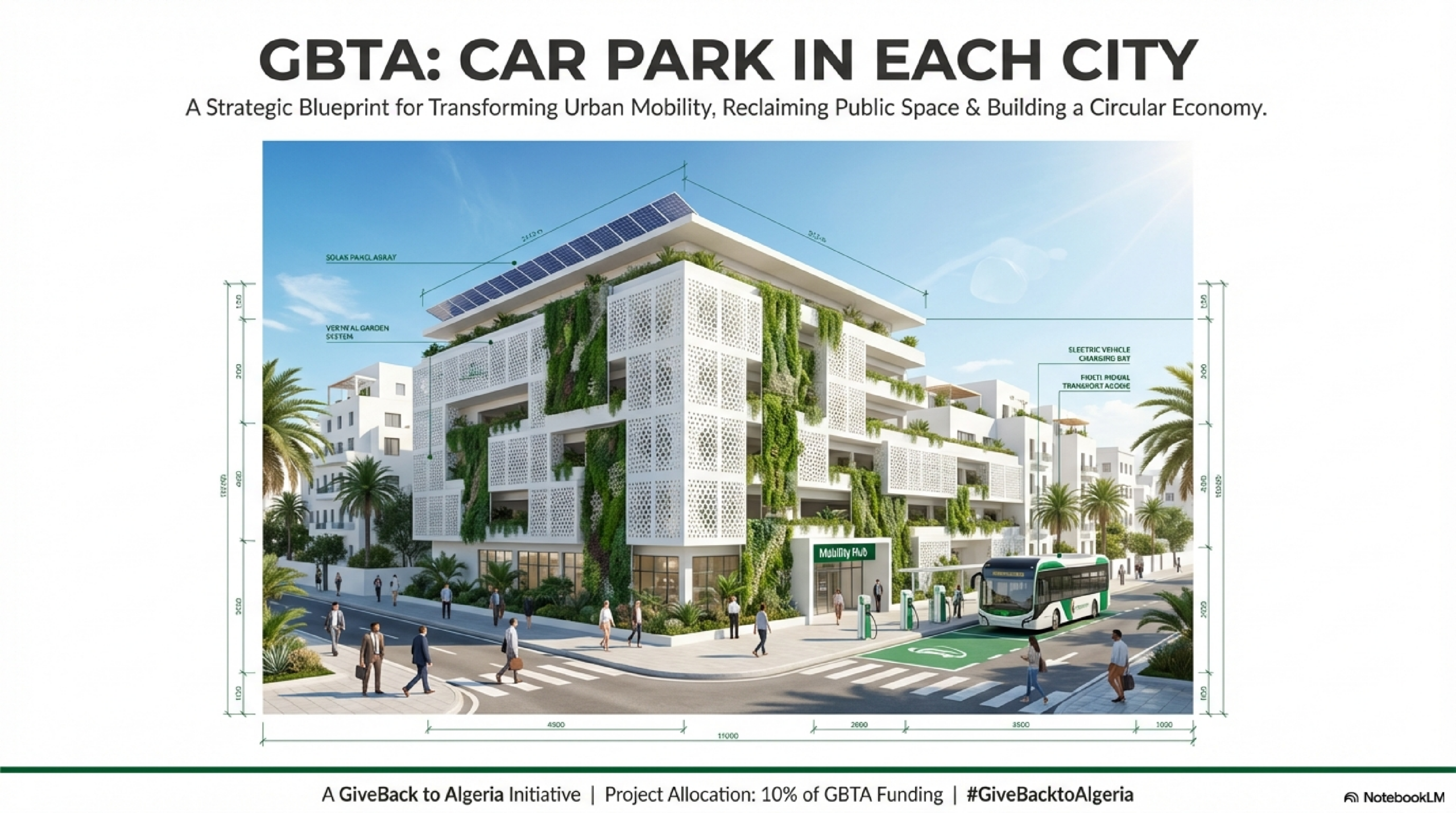
Car Park in Each City (and key neighbourhood hubs)
Project name
Car Park in Each City (10% of project funding)
Indicative allocation and scale
Total allocation: €320,625,000
Estimated number of projects: 54 car parks (one in each major city)
Average cost per project: €5,937,500
Core concept from the original page
The GBTA car park programme is designed to improve urban mobility by placing purpose-built car parks on the edge of city centres, encouraging people to park once and continue on foot or by public transport. This helps reclaim streets and pavements for pedestrians, while reducing congestion, emissions and noise.
How GBTA strengthens the project
GBTA treats parking as part of a wider, practical city model:
Park and ride sites at key entry points to city centres, aligned with local public transport options, including the Electric Bus project between neighbourhoods.
Neighbourhood hubs in high-demand zones such as markets, hospitals, civic centres and transport interchanges.
Pedestrian-first streets by moving parking off pavements and out of informal roadside spaces.
Why this matters
Unmanaged parking clogs streets, blocks pavements, increases journey times and worsens air quality. A structured network of car parks reduces time spent circling for a space, improves safety around schools and busy streets, and supports more liveable, walkable city centres.
Design and operating principles
Safety and confidence: strong lighting, CCTV, clear wayfinding, emergency points, staffed oversight.
Accessibility: step-free routes, lifts/ramps, clearly marked bays.
Future-ready: phased EV charging, cycle parking, and solar options where feasible.
Repeatable models: standard designs that can be scaled and adapted across Algeria’s 69 wilayas.
Revenue model with a public-interest focus
Parking fees are kept transparent and reasonable, with options such as hourly rates, resident packages and monthly subscriptions for frequent users. Additional income streams can include EV charging and small service units. The aim is to cover operations and maintenance, then reinvest any surplus into new GBTA projects.
Governance, transparency and asset lock
The national association safeguards the public-interest mission: standards, oversight, and published transparency reporting.
Al Amana Development delivers and operates the assets professionally, fully owned by the association.
Asset lock and non-distribution: no private profit extraction. Surpluses are reinvested into Algeria, reinforcing the circular economy loop GBTA is building.
Suggested delivery stages
Demand mapping and site selection
Land and legal structuring with full transparency
Design standards and mobility impact assessment
Construction and systems integration
Soft launch, then full operation
Monitoring, optimisation and phased expansion
Get involved
If you are an architect, engineer, mobility specialist, legal expert, or a community organiser, support the project by sharing it and inviting Algerians to use the hashtag #GiveBacktoAlgeria